

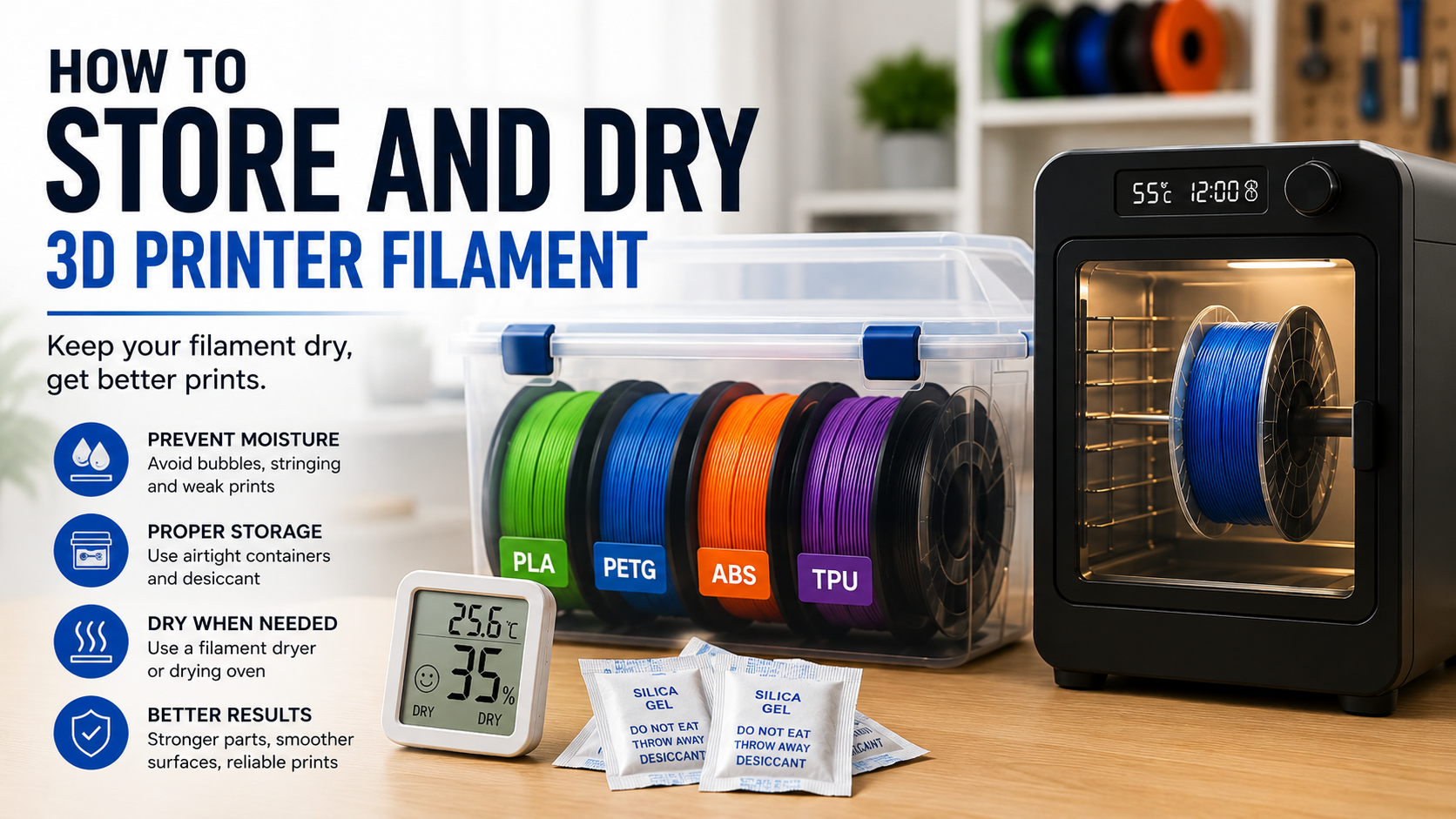
How to Store and Dry 3D Printer Filament
3D printer filament can absorb moisture from the surrounding air after its sealed packaging is opened. Over time, excessive moisture may reduce print quality, weaken layer adhesion and make extrusion less consistent.
Some materials absorb moisture much faster than others. PLA is generally easier to store, while TPU, PA, PC, PVA and other engineering materials usually require stricter moisture control. Highly hygroscopic materials may need to be dried before printing, even when they have been stored for only a limited period in a humid environment.
This guide explains how to recognize wet filament and how to store and dry it correctly.
Signs That Filament Has Absorbed Moisture
Wet filament does not always look different on the spool. The problem often becomes visible only during printing.
Common warning signs include:
- Popping or crackling sounds from the nozzle
- Excessive stringing
- Rough or uneven surfaces
- Small bubbles or holes in the extrusion
- Inconsistent filament flow
- Weak layer adhesion
- Brittle filament
- Unexpected changes in surface finish
These symptoms can also result from incorrect temperatures, poor retraction settings or a partially blocked nozzle. Moisture should therefore be considered as one possible cause rather than the automatic explanation for every failed print.
Which Filaments Need the Most Care?
Different materials react to humidity at different rates.
PLA
PLA is relatively easy to handle and may remain printable for a reasonable period in a controlled indoor environment. However, it can still absorb moisture, especially in humid climates or after long-term exposure.
PETG
PETG may develop stringing, rough surfaces and inconsistent extrusion when it becomes wet. Keeping opened PETG in a sealed container is recommended.
ABS and ASA
ABS and ASA are less sensitive than some engineering materials, but dry storage still improves consistency and helps prevent moisture-related defects.
TPU
Flexible TPU can absorb moisture and may produce bubbles, stringing and irregular extrusion. Dry storage is especially important because flexible material can already be more difficult to feed consistently.
PA, PC, PVA and Engineering Materials
PA, commonly known as nylon, is highly hygroscopic. PVA, BVOH, PC and many reinforced engineering filaments also benefit from careful storage and drying before use. Prusa specifically recommends keeping highly hygroscopic materials in a dry environment or drying them before printing.
How to Store Filament Correctly
The simplest method is to limit how much humid air reaches the filament.
Use:
- Resealable vacuum bags
- Airtight plastic containers
- Dedicated filament dry boxes
- Fresh desiccant
- A hygrometer for monitoring humidity
Place the spool inside the container immediately after use. Avoid leaving opened filament on the printer for days or weeks unless the room has consistently low humidity.
Silica gel or another suitable desiccant can help maintain a dry environment, but desiccant does not always remove moisture that has already entered the filament. Wet filament normally needs active heating in a suitable dryer before storage.
How to Dry Filament Safely
Filament can be dried using:
- A dedicated filament dryer
- A temperature-controlled drying oven
- A compatible printer drying system
- A heated dry box designed for filament
Always follow the drying temperature and duration specified by the filament manufacturer. Different polymers, blends and spool materials may require different settings.
Using excessive heat can soften the filament, deform the spool or cause strands to stick together. For example, Bambu Lab specifies particular drying conditions for each material; its PC filament guidance recommends 80°C for eight hours in an appropriate drying oven, illustrating why one universal setting should not be used for every filament.
A normal household oven is generally not ideal unless it can maintain a stable and accurately measured low temperature. Temperature fluctuations may damage both the filament and its spool.
Should You Print Directly from a Dry Box?
Printing directly from a dry box is useful for materials that quickly absorb moisture during long jobs.
This is particularly helpful for:
- PA and reinforced PA
- TPU
- PC
- PVA and BVOH
- Long engineering-material prints
- Humid workshops
A dry box helps keep the spool protected while the filament feeds into the printer. However, it should not be treated as a replacement for drying filament that is already wet.
How Often Should Filament Be Dried?
There is no single schedule that works for every user.
Drying frequency depends on:
- Material type
- Local humidity
- Storage method
- Time since opening
- Length of the print
- Manufacturer recommendations
- Visible printing symptoms
A spool stored correctly may remain usable for a long time. The same material left in an open and humid room may require drying much sooner.
Rather than drying every spool repeatedly, keep materials sealed and dry them when required by the material instructions or when moisture-related symptoms appear.
Final Thoughts
Correct filament storage is one of the easiest ways to improve printing reliability.
Store opened spools in airtight containers with suitable desiccant, pay particular attention to TPU and engineering filaments, and use controlled drying equipment when moisture has already entered the material.
Most importantly, check the instructions provided for the exact filament. Drying conditions can vary between PLA, PETG, ABS, TPU, PA, PC and specialty blends, so the product specification should always take priority over a general online temperature chart.