

PLA vs PETG vs ABS vs TPU: Which 3D Printer Filament Should You Choose?
Choosing the right filament is one of the most important decisions in any 3D printing project. The material affects not only how the finished part looks, but also its strength, flexibility, heat resistance, durability and ease of printing.
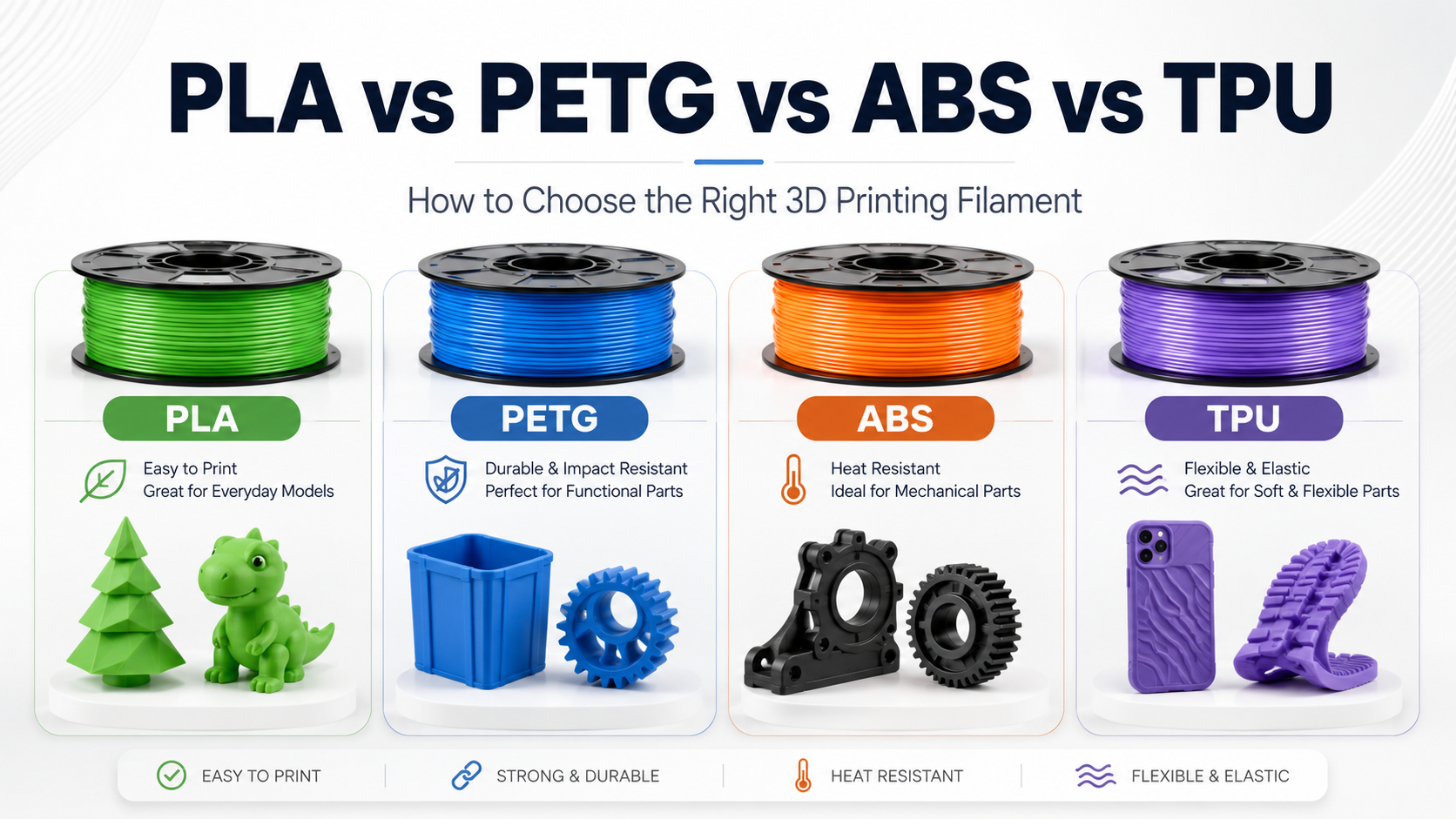
PLA, PETG, ABS and TPU are four of the most commonly used FDM 3D printing materials. Each one is suitable for different applications, printers and user experience levels.
This guide explains the main differences between these four materials and helps you decide which filament is the best fit for your project.
What Is PLA Filament?
PLA, or polylactic acid, is one of the most popular materials used in desktop 3D printing. It is easy to print, widely available and suitable for both beginners and experienced users.
PLA usually requires relatively low nozzle and build-plate temperatures. It also has low warping compared with many engineering materials, making it suitable for open-frame desktop printers.
Main Advantages of PLA
PLA offers good surface quality and dimensional accuracy. It is especially useful for models where appearance and detail are more important than high heat resistance or impact strength.
Common advantages include:
- Easy printing with minimal warping
- Good surface finish and fine detail
- Wide range of colors and finishes
- Suitable for most desktop 3D printers
- Good choice for beginners and educational use
Common Applications
PLA is commonly used for:
- Decorative models
- Display prototypes
- Toys and hobby projects
- Architectural models
- Educational projects
- Low-load functional parts
- Concept and appearance prototypes
Limitations of PLA
PLA can soften when exposed to higher temperatures and is more brittle than PETG or TPU. It is therefore not the best choice for outdoor parts, vehicle interiors or components that experience repeated impact.
Choose PLA when you need an easy-to-print material with good visual quality.
What Is PETG Filament?
PETG combines the easy printability of PLA with improved toughness and durability. It is a practical choice for functional parts that need more strength, moisture resistance or impact resistance than PLA can provide.
PETG normally requires a higher nozzle temperature than PLA, but it can still be printed on many desktop 3D printers.
Main Advantages of PETG
PETG is less brittle than PLA and performs well in many practical applications. It also offers good layer adhesion, which helps produce strong printed parts.
Common advantages include:
- Good toughness and impact resistance
- Strong layer adhesion
- Better heat resistance than standard PLA
- Good moisture and chemical resistance
- Suitable for many functional parts
- Relatively low warping
Common Applications
PETG is often used for:
- Functional prototypes
- Containers and holders
- Mechanical covers
- Workshop accessories
- Mounting brackets
- Protective parts
- Outdoor components with moderate exposure
- Parts requiring good layer strength
Limitations of PETG
PETG can produce more stringing than PLA and may require careful temperature and retraction adjustment. It can also stick strongly to certain build surfaces, so the correct build plate and release method should be used.
Choose PETG when you need a durable, practical material that is still relatively easy to print.
What Is ABS Filament?
ABS is a durable engineering plastic known for its impact resistance, heat resistance and post-processing capability. It has been widely used for functional prototypes, mechanical parts and product housings.
Compared with PLA and PETG, ABS usually requires higher printing temperatures and more controlled printing conditions.
Main Advantages of ABS
ABS is suitable for parts that must withstand mechanical use or moderately elevated temperatures.
Common advantages include:
- Good impact resistance
- Better heat resistance than PLA
- Suitable for functional and mechanical parts
- Can be sanded, drilled and machined
- Can be smoothed using suitable post-processing methods
- Good option for durable enclosures and housings
Common Applications
ABS is commonly used for:
- Mechanical prototypes
- Electrical enclosures
- Tool holders
- Automotive prototypes
- Functional housings
- Workshop parts
- Replacement components
- Parts requiring post-processing
Limitations of ABS
ABS is more likely to warp or crack during printing. For more reliable results, it should normally be printed in an enclosed printer with controlled temperatures.
ABS printing can also produce noticeable odors and emissions. A properly ventilated printing environment and suitable filtration system are recommended.
Choose ABS when you need a durable, heat-resistant part and have access to an enclosed 3D printer.
What Is TPU Filament?
TPU, or thermoplastic polyurethane, is a flexible and elastic material. Unlike rigid filaments such as PLA, PETG and ABS, TPU can bend, compress and recover its shape.
TPU is available in different hardness levels. TPU 95A is one of the most commonly used options because it offers a practical balance between flexibility and printability.
Main Advantages of TPU
TPU is designed for parts that need flexibility, grip, vibration absorption or repeated movement.
Common advantages include:
- Flexible and elastic
- Good abrasion resistance
- Strong impact absorption
- Good resistance to repeated bending
- Suitable for protective and non-slip parts
- Available in different hardness levels
Common Applications
TPU is commonly used for:
- Protective covers
- Flexible seals
- Grips and handles
- Vibration-damping parts
- Flexible hinges
- Cable management parts
- Non-slip feet
- Wearable components
- Protective bumpers
Limitations of TPU
Flexible filament can be more difficult to feed through the extruder than rigid material. Slower printing speeds and carefully adjusted retraction settings are usually required.
Not all automatic material systems are compatible with very soft TPU. Compatibility should be checked before loading flexible filament into an AMS or similar multi-material system.
Choose TPU when your part needs flexibility, impact absorption or repeated movement.
PLA vs PETG vs ABS vs TPU: Quick Comparison
Ease of Printing
PLA is generally the easiest material to print.
PETG is also relatively accessible but may require more adjustment to reduce stringing.
ABS requires better temperature control and is normally more suitable for enclosed printers.
TPU requires slower printing and careful filament feeding.
Strength and Durability
PLA provides good rigidity but can be brittle.
PETG offers a better balance of strength, toughness and layer adhesion.
ABS performs well in impact-resistant and heat-resistant applications.
TPU is flexible rather than rigid and is designed to absorb movement and impact.
Heat Resistance
PLA has the lowest heat resistance of the four materials.
PETG performs better under moderately elevated temperatures.
ABS is more suitable for parts exposed to heat.
TPU heat resistance depends on the exact grade and hardness.
Flexibility
PLA, PETG and ABS are mainly rigid materials.
TPU is the clear choice for flexible parts.
Recommended Printer Type
PLA works well with most open-frame and enclosed printers.
PETG works with most compatible desktop printers.
ABS is best used with an enclosed printer.
TPU requires a compatible extrusion path and is often easier to print with a direct-drive extruder.
Which Filament Should You Choose?
Choose PLA for decorative models, educational projects, prototypes and easy everyday printing.
Choose PETG for functional parts that need improved toughness, layer adhesion and moisture resistance.
Choose ABS for durable mechanical parts, enclosures and applications that require better heat resistance.
Choose TPU for flexible, protective, impact-absorbing or non-slip components.
There is no single filament that is best for every application. The right choice depends on the required mechanical properties, printing environment, printer configuration and final use of the part.
Final Thoughts
PLA, PETG, ABS and TPU cover a wide range of desktop and professional 3D printing applications.
For beginners, PLA is usually the best starting point. PETG is a useful next step for stronger functional parts. ABS is suitable for more demanding mechanical and heat-resistant applications, while TPU provides the flexibility required for seals, grips and protective components.
Before purchasing filament, always check the recommended nozzle temperature, build-plate temperature, drying requirements and printer compatibility.
Choosing the correct material from the beginning can improve print quality, reduce failed prints and help ensure the finished part performs as expected.